
 中文
 Tiếng Việt


Student Profile
Student Name:
Ginny
Current School:
Dana Hall School
Admitted to:
Cornell University, UC Berkeley, USC, NYU, Northeastern, CUHK, and others
Overview
Ginny, a current student at Dana Hall School, was admitted to top universities including Cornell University, UC Berkeley, USC, NYU, Northeastern University, the Chinese University of Hong Kong, and other universities in the 2026 admissions cycle. After 4 years of academic exploration, research, leadership, and unexpected health challenges, she chose Cornell University’s College of Engineering and gained a clearer understanding of her interests and future goals.
Student Background
Ginny entered high school carrying strong academic abilities, an interest in STEM, and the motivation to pursue challenging opportunities. Throughout high school, she maintained nearly straight A’s and was inducted into the Cum Laude Society, an academic honor society recognizing students’ outstanding scholastic achievement. However, Ginny’s interests went well beyond the classroom.
At Dana Hall School, she joined the business club in 9th grade and competed in the Diamond Challenge, an international entrepreneurship competition. Her team advanced to the top 68 among nearly 1,000 participating teams. She was involved in business activities throughout high school, eventually becoming president of her school’s business club and founding its Future Business Leaders of America (FBLA) chapter.
She also became captain of the fencing team, despite having no fencing experience before high school. She also joined the student government, served as a boarding student representative, and participated in the school’s Discipline and Responsibility Committee.
Ginny also explored several academic disciplines. She took computer science courses through MIT Beaver Works, conducted toxicology research, and attended a Harvard medical course. These experiences introduced her to the world of programming, data analysis, biology, materials science, and other fields.
Her broad interests gave her many valuable opportunities to learn and grow, but they also raised an important question: With so many possible majors and careers available, which one should she focus her time and energy on?
Challenge
For Ginny, it wasn’t about a lack of opportunities; it was about deciding which ones were meaningful enough for her to pursue.
She could continue an existing research project, explore a new subject, attend a summer program, or take on additional leadership responsibilities. Each choice took time and effort, and even a highly motivated student could not pursue everything.
In 9th Grade, Ginny began working with Ivy Talent, initially with a general interest in science and engineering rather than a specific major. She needed a flexible long-term plan that would let her explore different fields while gradually developing academic expertise.
However, when she was in high school, she underwent two major surgeries and related treatments. These experiences interrupted her planned academic, research, and extracurricular activities, requiring adjustments to her schedule and priorities.
Recovering from these medical conditions also sparked Ginny’s serious interest in medicine, just in time for the college application season.
Ginny faced challenges both in her academics and personal life, but how did she develop a coherent application direction without dismissing her evolving interests or placing unnecessary pressure on her health?
How We Helped: Turning Exploration Into Purposeful Choices
Finding an Academic Direction Without Rushing the Decision
When we first began working with Ginny at Ivy Talent, we did not ask her to commit immediately to a specific major.
Instead, we discussed her favorite subjects, academic strengths, intellectual interests, and the experiences she wanted to try. We also helped her evaluate different opportunities based on their potential value, time commitment, and connection to her long-term goals.
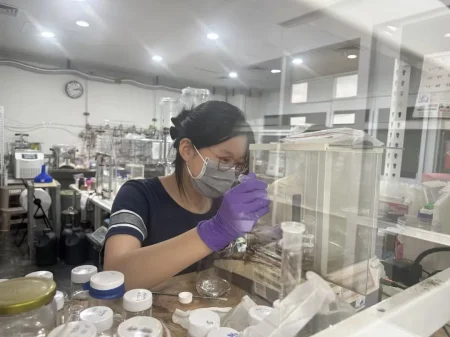
Through continued exploration and discussion, Ginny gained interest in chemical engineering and energy materials as areas she wanted to study more deeply. Once that direction became clearer, we helped her explore research opportunities in university laboratories.
At first, the laboratory environment was unfamiliar for Ginny. She encountered technical terminology, formulas, and research methods she had never studied before. She often filled more than 10 pages with unfamiliar concepts and spent additional hours reviewing them independently. Over time, she became more comfortable discussing research questions with professors and graduate students.
Her research involvement eventually expanded beyond learning established methods to developing research topics, preparing academic papers, participating in conferences, and contributing to several patent applications.
These experiences gave Ginny a sustained foundation in research and helped her understand what meaningful academic work involves.
Making Room for Leadership and Other Interests
Although chemical engineering became Ginny’s primary academic focus, we encouraged her to continue pursuing the activities she genuinely enjoyed.
Her business activities, fencing, student leadership, and interdisciplinary studies offered different opportunities for her development.
Leading the business club and founding an FBLA chapter involved organization and collaboration. Fencing required persistence and teamwork, particularly because she entered the sport without prior experience. Her student government and committee responsibilities exposed her to different perspectives within the school community.
Rather than treating every extracurricular activity as another credential, we worked with Ginny to consider which commitments she genuinely enjoyed and wanted to continue.
This approach helped her recognize that a meaningful high school experience does not require pursuing every available opportunity. It requires making thoughtful choices about where to invest her time and energy.
Adjusting the Plan When Health Became the Priority
In high school, Ginny’s surgeries created circumstances that no long-term college plan could have fully anticipated.
During her recovery, we worked with Ginny and her family to reassess upcoming commitments. Her core academic courses and grades remained the priority, while projects that could be postponed were rescheduled. We also avoided giving her unnecessary workload during her recovery.
At the same time, her personal medical experiences led her to reconsider her academic interests. Ginny began to wonder whether medicine might be a field she wanted to pursue seriously.
Instead of immediately telling her to change her major, we encouraged her to explore medicine through direct experience. We helped her identify biomedical coursework and practical experiences related to medicine and healthcare. These opportunities confirmed that her interest in the medical field was worth exploring further.
However, the application season was approaching, and changing her academic direction late required careful consideration. Therefore, we developed different strategies for her U.S. and Hong Kong university applications.
For U.S. universities, Ginny pursued chemical engineering as her primary intended direction while incorporating her interest in medicine and healthcare whenever relevant. For universities in Hong Kong, where changing a program can be less flexible, we explored applications in bioengineering and health-related fields.
This allowed Ginny to acknowledge her evolving interests while building on the preparation she had already completed.
Finding the Personal Story Behind the Medical Experience
During her medical recovery, Ginny experienced a period when she could not speak. As she reflected on that experience with our team, she began to think more deeply about communication, listening, and the challenges people face when they cannot easily express themselves.
This awareness carried into her responsibilities at Dana Hall. As a member of the Discipline and Responsibility Committee, she encountered difficult situations involving different student perspectives and learned to listen carefully and help others communicate their concerns.
Her revised college essay connected her experiences to developing a sense of empathy and responsibility. Rather than focusing solely on the medical events themselves, Ginny had come to understand and respond to other people differently.
A College Decision Guided by Personal Fit
Ginny’s admissions results gave her several strong options, including Cornell University, UC Berkeley, USC, NYU, Northeastern University, and the Chinese University of Hong Kong. Choosing among them introduced another important conversation.
Ginny and her parents did not always prioritize the same factors. Her mother focused more on career prospects and future employment opportunities. Ginny greatly emphasized her academic interests, research opportunities, and ability to explore her chosen fields in depth.
We helped the family systematically compare universities based on academic programs, available resources, and educational approaches. We also worked with Ginny to connect her research background with the opportunities she hoped to pursue in college.
After considering these factors and discussing their different perspectives, Ginny chose Cornell University’s David A. Duffield College of Engineering. Her decision reflected not only the admissions opportunities she had gained, but also a clearer understanding of her interests that she had developed throughout high school.
What Her Family Wants to Say
Looking back on Ginny’s 4 years of high school, her mother emphasized that Ginny’s development was not simply about the number of college acceptances. It was watching Ginny become more independent, resilient, and capable of navigating uncertainty.
Her mother also started to view college planning differently. As academic achievements remained important, Ginny’s health, happiness, and ability to make decisions for herself mattered as well.
Ginny’s journey from her broad STEM interests to pursuing a degree in Cornell Engineering was never a perfectly straight line. It included ambitious research, unexpected medical challenges, new intellectual interests, and difficult choices about which field to pursue.
At Ivy Talent Education, we value the opportunity to support students through journeys like Ginny’s, where thoughtful planning leaves room for both ambition and change. For families starting to consider their college admissions journey, we welcome you to schedule a free consultation to discuss your child’s interests, goals, and possible next steps.