
 中文
 Tiếng Việt


Whether your child has already been accepted to a boarding school or you’re still building a school list, choosing the right school involves more than comparing rankings. A School Profile and college matriculation list can help you understand the school’s curriculum, grading policies, academic environment, and college decisions.
These documents are often prepared for college admissions officers, but families can use them as well. They offer context that a school viewbook or ranking may not provide and help you ask more informed questions about which school your child could thrive in.
Where to Find a School Profile
Many schools publish their profiles on the Academics section of their website, often under College Counseling or College Advising.
If you can’t find the profile on the school’s website, search for the school’s full name along with ‘school profile.’
These documents are only a few pages long. Unlike a school viewbook, which is designed to introduce and promote the school, a school profile focuses on academic information and data that can help with comparisons.
Here’s What to Look For: 6 Sections That Matter
1. Student Body and Resource Allocation
Most profiles open with basic school information: the school’s founding year, whether the school is single-sex or coed, and its stated mission. They usually follow with a data summary covering total enrollment, a breakdown of boarding versus day students, student-teacher ratio, and financial aid figures.
Here is an example of Phillips Academy Andover’s 2025-2026 profile:
| Metric: | Data: |
| Total enrollment | 1,172 students |
| Boarding students | 861 |
| Day students | 311 |
| Geographic reach | 41 states and 53 countries |
| Students of color | 61% |
| Students receiving financial aid | 47% |
| Total annual financial aid | $29.9 million |
Enrollment size alone doesn’t tell you whether the school’s resources are stretched thin. What matters more is how enrollment relates to the student-teacher ratio and the school’s overall investment in support services.
Enrollment size can shape how a school organizes its academic and personal support, but it does not determine how much attention an individual student receives. Look at the student-teacher ratio alongside advising arrangements, faculty accessibility, academic support services, and the school’s expectations for student independence. Smaller schools may offer a different support structure, but families should evaluate the actual resources available, rather than relying on enrollment size alone.
Neither model is better than the other. The right question families should ask is: which environment matches how your child learns?
Beyond the core statistics, sections on diversity, global learning, and community initiatives can offer insight into the school’s priorities and values.
2. Curriculum and How Advanced Courses Are Labeled
The curriculum section is the most information-dense section of any profile and the one that families most often misread.
Many parents evaluate a school’s academic rigor by counting AP courses. This can be misleading because some boarding schools use their own advanced-course designations or offer college-level coursework outside the AP framework.
The following examples show how boarding schools approach advanced coursework in different ways:
Loomis Chaffee operates on a trimester system and doesn’t use the traditional AP framework. Its highest-level courses are designated CL (College Level), with 55 CL courses and 19 Advanced courses offered school-wide. The school states explicitly that these courses are equivalent to or more demanding than AP courses. It also notes that prerequisite requirements and scheduling constraints make it difficult for a typical student to complete seven CL credits and four Advanced courses over four years, which shows how genuinely selective the pathway is.
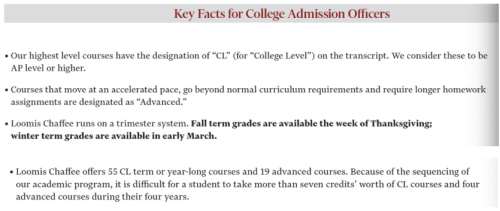
Source: Loomis Chafee School Profile
Peddie School takes a more conventional approach, offering AP and Honors courses across 35 subject areas, with 22 official AP courses in English, history, math, music, world languages, visual arts, and science. Notably, the school limits students to three AP courses per academic year (in most cases) and offers two post-AP mathematics courses for students who have completed calculus.
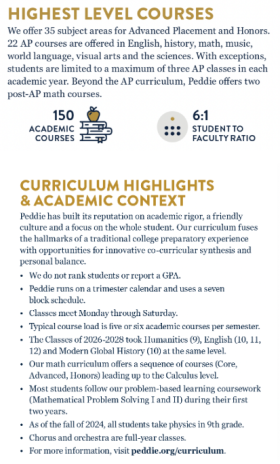
Source: Peddie School Profile
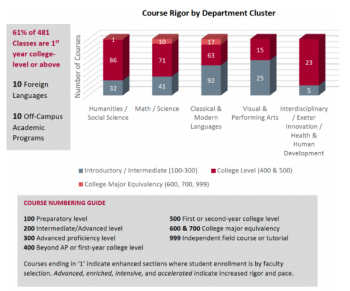
Phillips Exeter Academy doesn’t offer AP courses at all. This school states that its curriculum frequently exceeds AP depth. It uses a 100-999 course numbering system, where 400-level courses go beyond AP or equivalent to first-year college work, 500-level corresponds to first- and second-year college work, and 600 and 700-level courses reach upper-level college depth. The school reports that 61% of its courses are at first-year college level or above. Students can also design independent courses or research projects with faculty guidance, designated 999 and SRP 400.
Deerfield Academy has also been gradually moving away from AP. Many of its courses use college textbooks and follow undergraduate pacing. Some courses are explicitly post-AP, requiring completion of the corresponding Honors or AP course first. The school retains official AP designation only in mathematics, arts, and AP Seminar, but students can still voluntarily sit for AP exams.
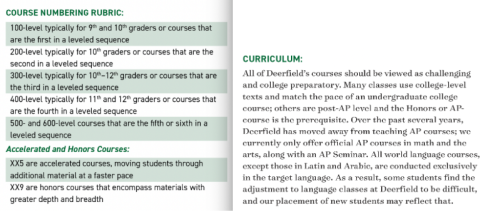
Source: Deerfield Academy School Profile
Rather than focusing solely on whether a school offers AP courses, look at how it structures advanced coursework and evaluates academic rigor. A school’s course catalog can help you understand the depth of its offerings and the expectations placed on students.
To give you a bigger picture, most schools publish a complete Course Catalog under the Academics section of their website.
3. Signature Programs and Distinctive Offerings
Many schools use their profile to highlight flagship academic programs. These programs can reflect a school’s priorities and give students opportunities to explore specific academic interests in greater depth.
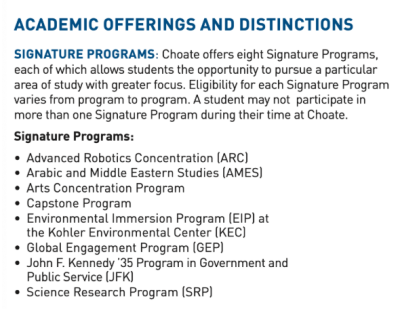
Choate Rosemary Hall offers eight Signature Programs, and students may participate in only one during their time in the school. It offers a broad selection of programs, such as the Arts Concentration Program, the John F. Kennedy ’35 Program in Government and Public Service, and the Environmental Immersion Program at the school’s Kohler Environmental Center, which involves immersive research projects.
Hotchkiss School leans more toward academic research. Its MacLeish Scholars Program has students conduct archival research on a literary theme, produce a substantial original writing project, and learn traditional papermaking, bookbinding, and letterpress printing. Participants spend part of the summer conducting research at Yale’s Beinecke Rare Book Library, then continue through a year-long Honors Literary Research course culminating in a roughly 40-page paper.
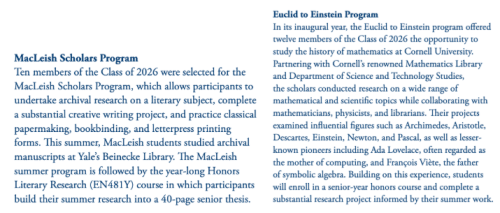
Source: Hotchkiss School Profile
Programs like these give students something specific and substantive to write about for their college applications. When comparing schools, consider whether a signature program genuinely aligns with your child’s interests.
4. Grading Systems and GPA Policy
This part is where families most often get confused because nearly every boarding school has its own grading framework, and those differences directly affect how colleges view your child’s transcript.
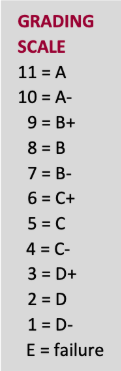
Phillips Exeter Academy uses a 0-11 numerical scale, corresponding to traditional letter grades from E (failing) through A (highest). This profile explains how the scale functions:
St. Paul’s School made a significant change starting in the 2025-26 academic year, replacing its previous 7-point scale (from High Honors to Commendation to Unsatisfactory) with the more conventional A+ through F system corresponding to a 4.3-0.0 GPA. The school explained the change as an effort to make student performance more clearly and consistently interpretable to colleges.
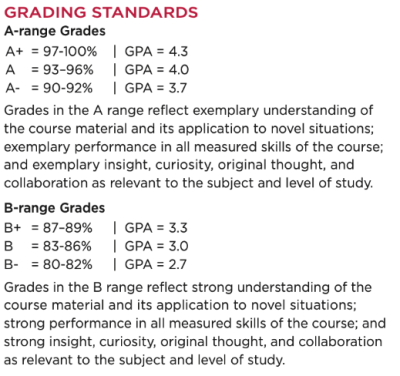
Source: St. Paul’s School Profile
This change is a useful reminder to always check the grading table for the current academic year, rather than relying on older information or what other families report.
Profiles typically also explain the thresholds for academic honors, like Honors and High Honors, along with criteria for school prizes and awards. These details can change from year to year, so always check the school’s website for the latest information.
5. Standardized Test Results and Academic Performance
Profiles present test score data, but how schools display them meaningfully varies, and these differences matter.
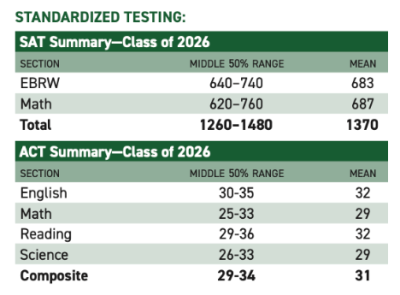
Deerfield Academy publishes its Class of 2026 SAT and ACT middle 50% ranges. For SAT, the middle 50% scored between 640 and 740 on Evidence-Based Reading and Writing, with a mean of 683. Math scores ranged from 620 to 760, with a mean of 687.
Source: Deerfield Academy School Profile
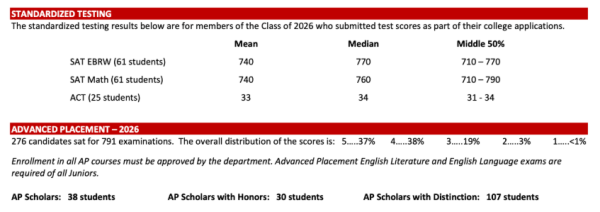
Middlesex School includes median scores alongside averages. For the Class of 2026, 61 students submitted SAT scores, with mean scores of 740 in both sections but medians of 770 and 760, respectively.
Comparing the mean and median can help families understand how test scores are distributed. When the median is higher than the mean, lower scores may be pulling the average down. However, these two figures alone do not show the full distribution, so families should interpret them alongside the reported score ranges and the number of students represented.
Source: Middlesex School Profile
Some schools also publish AP exam data. Middlesex reports that its Class of 2026 took 791 AP exams across 276 students, with a full score distribution and counts of students earning AP Scholar, AP Scholar with Honors, and AP Scholar with Distinction recognition awards.
Averages and middle 50% ranges provide different kinds of information. An average offers a quick snapshot of overall performance, while the middle 50% range shows where the scores of the central half of test-takers fall. Looking at both can give families a more complete picture of a school’s reported results.
6. College Counseling Team and Contact Information
Many school profiles list the college counseling team and provide contact information. Reaching out to school counselors early, rather than waiting until application season, gives you a clearer understanding of the school’s course planning, application timelines, and approach to college advising. These conversations can provide context that may not be included in the profile itself.
How to Read a Matriculation List
Matriculation lists show where graduates enrolled, not every college that admitted them. A student may receive several offers but ultimately enroll only at one institution. As a result, matriculation data cannot tell you how many admission offers a school’s students received or how many offers any particular college made.
Three Ways Schools Present Matriculation Data:
1. Multi-year totals with threshold markers
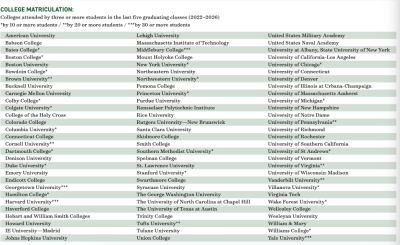
Deerfield Academy publishes a list of colleges with three or more students enrolled across the past five graduating classes (2022-2026). It uses asterisks to indicate volume: one asterisk for more than 10 students, two for more than 20, and three for more than 30. Georgetown, Harvard, Middlebury, and Yale all carry three asterisks.
Source: Deerfield Academy School Profile
2. Year-by-year breakdowns
Loomis Chaffee publishes separate lists for the Class of 2025 and for the previous three years combined, allowing families to see both a single-year snapshot and multi-year trends.
Source: Loomis Chaffee School Website
3. Precise enrollment counts
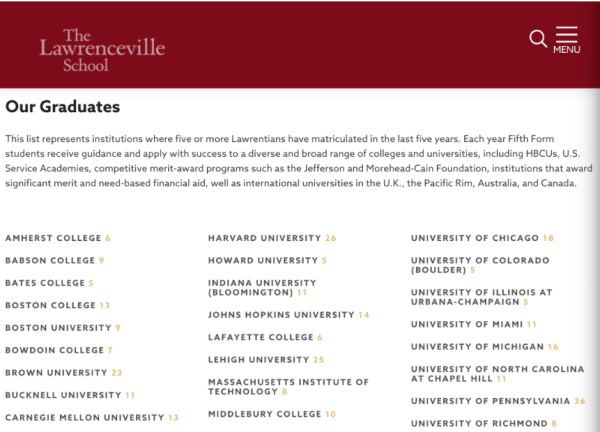
The Lawrenceville School lists exact numbers of students who enrolled at each college over five years. This is more transparent than ranges or asterisks, but you must pay attention to whether the count covers one year or five years. Reading a five-year total as an annual figure will significantly overstate how many students actually go to a given school in each year.
Source: The Lawrenceville School Website
What the Numbers Don't Tell You
Raw matriculation numbers need context. For example, St. Paul’s School includes a note on its matriculation page that illustrates why. Out of 154 graduates in the Class of 2025, 147 enrolled directly in college. Of the remaining seven, six took a gap year for athletic reasons (hockey, rowing, basketball).
This kind of detail matters. Matriculation lists include recruited athletes, legacy applicants, and students with other distinctive circumstances.
Using aggregate matriculation numbers to estimate an individual student’s chances at a particular college can be misleading. The list does not show every applicant’s academic record, extracurricular profile, intended major, or other circumstances. Treat the figures as context about past enrollment patterns, not as a prediction of your child’s admission outcome.
Instead, ask whether the students represented on the list have academic backgrounds, interests, and experiences similar to your child’s. Even then, matriculation data should be treated as context rather than a forecast of admission outcomes.
Not every school publishes complete matriculation data in the school profile itself. Many include only a summary or the most recent year. The full lists are often available on a separate page of the school’s website.
How to Use School Profiles When Comparing Boarding Schools
A School Profile isn’t simply a ranking. It explains how a specific school works, and each school presents its information differently. Understanding the logic behind how a school presents its data is often more valuable than looking at a single number.
Whether you’re comparing boarding schools or deciding among offers, you can download the profile for each school on your list and read through the sections above systematically. Many schools also post recordings of college counseling webinars from previous years, which offer additional insights into how the school approaches its college process. You can also reach out to the college counseling office early, rather than waiting for the application season.
If you’d like help interpreting a school’s profile or comparing boarding school options, our team at Ivy Talent Education can help. You can also explore our student success stories to learn how we have helped students gain admission to selective boarding and day schools.
Schedule a consultation with us today, and we can help you look beyond the rankings and evaluate which school may fit your child’s learning style, interests, and goals. Reach out to schedule a consultation, and let’s discuss your family’s options!