
 中文
 Tiếng Việt

When the school year ends, families may ask, “What grades did my child get?”
A U.S. high school report card can tell a deeper story than just numbers. It may show a student’s grades for individual terms, course levels, teachers’ comments, and other information that will help explain their academic progress. Some schools use letter grades or percentages, while others use numerical scales that may look unfamiliar to families living outside the United States.
Getting a “B” in one course may mean something different than getting a B in another. A student’s overall GPA cannot always capture the difficulty of their academic program or the progress they have made over time.
Families with children attending U.S. private or boarding schools should not simply determine whether a grade is high or low. They must understand what the report card reveals about their child’s learning, identify areas that may need more attention, and make thoughtful decisions about future courses.
1. Understand the Grading System Before Interpreting the Grades
There is no single grading system that is used by every U.S. private high school. Before you compare grades or calculate an average, you can identify how your child’s school evaluates academic performance.
Percentage Grades
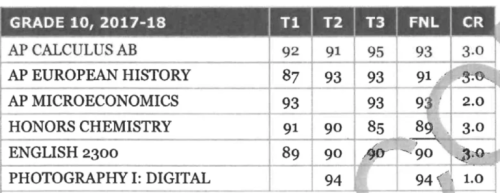
Some schools calculate grades as percentages, such as 92 or 85. A report card may list a student’s grades for individual marking periods alongside a final course grade.
However, that percentage alone does not tell you how the school interprets one’s performance. A grade of 90 may represent an “A” at one school, while another school may use a different grading system. It is best to use the individual school’s grading policy as a reference.
In interpreting grades, you need to look for:
- The grading scale and letter-grade equivalents.
- Whether the displayed grade is a term grade, a semester grade, or a final course grade.
- Whether different assignments or assessment categories carry different weights.
- Any comments explaining a particularly strong or weak result.
Do not assume that the highest number on the report card automatically represents the same level of achievement for every school.
Letter Grades
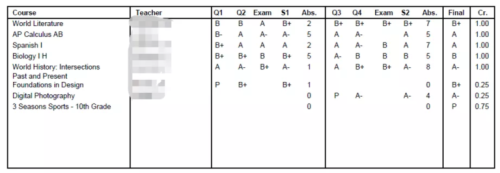
Other schools calculate grades using letters, such as A, B, C, and D, sometimes including plus or minus distinctions.
A report card may show separate grades for the fall and spring terms, along with a final grade for the course. This format can make it easier to see whether a student’s performance is consistent throughout the year.
For example, a student who gets a B in the fall and an A in the spring may have made meaningful progress. Another student who gets an A in the fall and a C in the spring may need guidance in identifying what changed.
Although the final grade matters, the previous grades leading up to it can also provide important context.
Numerical Scales (Including Phillips Academy Andover’s 0–6 System)
There are some schools that use grading scales that do not resemble the familiar 100-point or A–F systems.
For example, Phillips Academy Andover uses a 0–6 grading scale for most credit-bearing courses, with 6 representing outstanding performance, 5 for superior performance, and 4 for good performance. Lower scores represent progressively weaker performance. However, certain courses may use the pass/fail grading system.
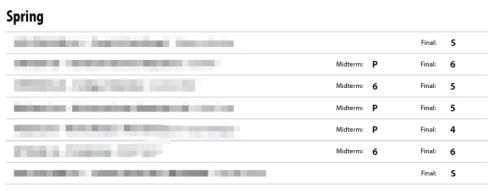
Andover’s official Course of Study explains the school’s grading and reporting practices. Its grading scale should be interpreted according to the school’s own definitions, not converted mechanically into another school’s system.
According to its published school profile, Andover also does not calculate a cumulative grade average or rank students. This shows why families should not assume that every private school calculates a GPA in the same way.
Here’s what parents should do: If they find a grading scale unfamiliar, they can ask the school for its official grading policy. Before comparing grades across schools or years, they should confirm what the numbers mean and how the school reports a student’s final performance.
2. Look Beyond the Final Grade
A final course grade may be important, but it does not necessarily explain how a student earned it.
Depending on the school and course, grades may reflect a combination of homework, quizzes, tests, projects, essays, presentations, laboratory work, and class participation. The exact mix varies per teacher, department, and school.
Rather than assuming every school calculates grades the same way, you can use the syllabus or grading policy to understand what contributes to the final result.
Review the components that matter for each course
Suppose a student gets a “B” in English. That grade could reflect their strong analytical essays but inconsistent homework completion. For another class, that same grade could reflect good preparation but difficulty with timed assessments.
If the school provides assignment-level information or separate assessment categories, you can look for these patterns:
- Tests and quizzes: Does the student understand the material but struggle to demonstrate that understanding under time pressure?
- Essays and projects: Are research, organization, argumentation, or revision skills areas for growth?
- Homework and preparation: Is the student completing assignments consistently and keeping up with the workload?
- Class participation: Is the student contributing to discussions, asking questions, and engaging with the material when class participation is part of the course expectations?
These categories are only examples, not a universal grading formula. A school may not report them separately, and participation or effort may not directly affect the final grade in every course. Families must understand the specific reasons behind a result rather than treating the grade as a complete explanation for a student’s performance.
Read teacher comments carefully
Teacher comments can be useful when they explain strengths, challenges, or changes that are not obvious from a student’s grades alone.
A teacher might note that a student understands complex concepts but needs to support arguments with stronger evidence. Another teacher might describe excellent written work alongside inconsistent class preparation.
These observations can help families spot differences between a knowledge gap, a study-habit issue, and a challenge with a particular type of assignment.
Not every school gives detailed comments on the report card. Some schools provide separate progress reports or teacher feedback through a parent portal.
If you find the comments brief or unclear, consider asking the teacher for a specific example and a practical next step to take. Having that conversation is usually more productive than simply asking how the student can raise a B into an A.
3. Interpret Grades in the Context of Course Difficulty
A student’s grades should be considered alongside the courses they take and the academic opportunities available at their school.
For example, two students might both get an A in mathematics, but one student may be taking a more advanced mathematics course. That difference can be used to evaluate their academic performance. However, it does not automatically mean that one student has learned more than the other or is more prepared in every aspect.
Since the course title alone is not enough, families should also consider the curriculum, prerequisites, pacing, and workload.
How do you know whether a course is challenging enough?
You can start by reviewing the school’s course catalog and the student’s previous coursework. These can give you information on prerequisites, course sequences, and expectations for moving to the next level.
Some useful questions include:
- Is the student taking courses appropriate to their current preparation and interests?
- Are they making progress through the school’s available course sequence?
- Does the next course offer them a meaningful academic challenge?
- Can the student manage the academic workload while maintaining a healthy balance across different subjects?
Advanced courses can show a student’s willingness to engage with challenging material, but having difficulty at the expense of learning or performance is not necessarily a good strategy.
This context matters for college-bound students because admissions officers consider both their academic performance and course rigor. In its admissions FAQs, Princeton explains that it reviews report cards course by course and considers the rigor of the academic program depending on what the high school offers. Princeton also gives equal consideration to applicants from schools that do not weight grades or rank students.
Students should not take the largest possible number of advanced courses. Instead, they should pursue a challenging, balanced program that fits their abilities.
4. Do Not Judge Academic Performance by GPA Alone
Some schools calculate an unweighted GPA, some add weight to designated advanced courses, and others do not report a cumulative GPA at all.
These differences can make comparisons confusing, especially for families who are accustomed to a standardized numerical measure of academic performance.
However, a school’s GPA system does not determine how competitive a student will be in college admissions.
Colleges also interpret academic records in context. They may consider the report card, course descriptions, school profile, counselor report, and other information from the high school.
In its guidance on what it looks for in applicants, Yale explains that grades and other quantitative measures are interpreted by admissions officers rather than by a formula. Yale specifically states that its admissions officers do not simply unweight or reweight GPAs.
At the same time, families should not assume that every college recalculates every applicant’s GPA using one universal standard. Different institutions have different review processes, and some may use internal calculations for specific purposes.

What if the school does not rank students?
If the school does not rank its students, that is not automatically a disadvantage. Princeton explicitly states that it gives equal consideration to applicants from schools that do not weight grades or rank students.
A school’s grading and reporting system is part of what admissions officers consider. The important question is whether the student has performed well relative to their school’s opportunities and expectations.
What if a GPA looks high but is not unusual at the school?
A GPA is more informative when it is considered alongside course difficulty and the school’s grading practices. If many students earn similar grades, their GPA alone may reveal relatively little about a student’s academic strengths.
This does not mean that the GPA is meaningless. It means that families should avoid using it as the only measure of progress or readiness for college.
Instead, review the full report card and ask the school counselor how the student’s academic record is presented in the school report.
5. Track Academic Trends Across Terms and Years
A report card is a record of a student’s performance over time, not just a collection of their final grades.
Looking at the changes between terms can help families identify progress, recurring difficulties, or shifts in the student’s workload.
Consider these two examples:
| Student | Fall Grade | Spring Grade | What to Investigate |
| Student A | C | B | What helped the student improve, and how can that progress continue? |
| Student B | A | C | What changed in the course, workload, preparation, or personal circumstances? |
Student A’s improvement is encouraging, although the family should still understand what made the course difficult in the first place. Student B’s decline deserves attention, but it should not automatically be interpreted as a lack of effort or ability.
A more challenging unit, a change in assessment style, competing responsibilities, or a gap in foundational knowledge could each contribute to the pattern.
Look at the broader academic record
One difficult term does not necessarily define a student’s academic ability. Likewise, a strong final grade does not always mean that every underlying skill is secure and will transfer to other terms or subjects.
When reviewing a report card, you can consider:
- Consistency: Are grades stable across subjects, or are there recurring difficulties in a particular area?
- Improvement: Has the student made progress after receiving feedback or additional support?
- Course progression: Is the student taking increasingly demanding courses when appropriate?
- Recent performance: Are current grades consistent with the student’s previous record?
Yale’s guidance on course selection emphasizes the importance of academic context and trends. The university notes that recent courses and grades can be especially informative when evaluating a student’s preparation for college-level work. Families should look for explanations and next steps to take rather than basing decisions on a single number.
6. What Should Parents Do When Grades Decline?
If your child’s grades are dropping, a downward trend is a reason to investigate, not a reason to panic.
You can start by identifying where the change took place. Is the student struggling in one course or across several subjects? Did the decline begin after a change in course difficulty, teacher expectations, or workload? Are their assignment grades falling, or is the final result being affected by one major assessment?
Once the pattern is clearer, you can speak with your child and the teacher or school advisor, when appropriate.
The conversation should focus on these specific questions:
- Which assignments or skills have been the most difficult for the student?
- Does the student understand the feedback they have received?
- What changes have they already tried?
- What support is available through the teacher, advisor, tutoring, or academic support services?
- When should their progress be reviewed again?
A student who struggles with essay organization may need a different kind of support from another student who understands the material but has difficulty in managing deadlines.
Families should also avoid assuming that tutoring is always the answer. Sometimes, the most useful change is having a better study routine, clearer communication with a teacher, or a more realistic balance of activities and coursework.
If the student is considering a more advanced course for the next term, discuss whether the current foundation will prepare them for that course. Course selection should reflect both a student’s long-term goals and their present academic needs.
7. Use the Report Card to Plan for the Next School Year
End-of-year grades can help families make informed decisions about the next academic year. They are most useful when combined with teacher feedback, the student’s interests, and the school’s course requirements.
Before finalizing a schedule, you can review the following:
Course placement and prerequisites. Confirm which courses the student is prepared to take next and whether any prerequisites or placement assessments apply.
Academic balance. Consider the workload across all subjects. Having a demanding schedule can be valuable, but it should leave room for meaningful engagement and sustainable study habits.
Areas for growth. Identify one or two skills that would make the greatest difference to a child’s growth, such as analytical writing, mathematical foundations, laboratory skills, or time management.
Student interests. If a student has developed a strong interest in a subject, explore relevant courses or independent academic opportunities when available.
Teacher and advisor recommendations. Ask what the student should prioritize and whether the proposed schedule is appropriate given their academic performance and goals.
Families should avoid choosing courses solely to boost their child’s GPA or make their report card more impressive. A well-considered academic plan is one that helps the student learn while preparing for future opportunities.
A Practical End-of-Year Report Card Review
Before the new school year begins, set aside time to review your child’s report card with them. This checklist can help keep the conversation more focused:
- Confirm the grading scale and understand what the reported grades represent.
- Review final grades alongside term grades, assignment information, and teacher comments where available.
- Identify two or three academic strengths worth building on.
- Identify any recurring challenges that need attention.
- Discuss whether the next course sequence is appropriate.
- Contact teachers or the school advisor if a grade or comment is unclear.
- Set one or two realistic goals for the next term.
The goal is not to turn the report card assessment into judging the student. It is using that information to understand what works for them, where they need support, and what they are ready to tackle next.
A report card is only one part of a student’s academic experience, but it can be a useful starting point for meaningful conversations between students, families, and schools.
If you need help understanding your child’s academic record, evaluating course options, or planning for future college applications, contact Ivy Talent Education to speak with an education consultant about your family’s goals and next steps.