 中文
中文 Tiếng Việt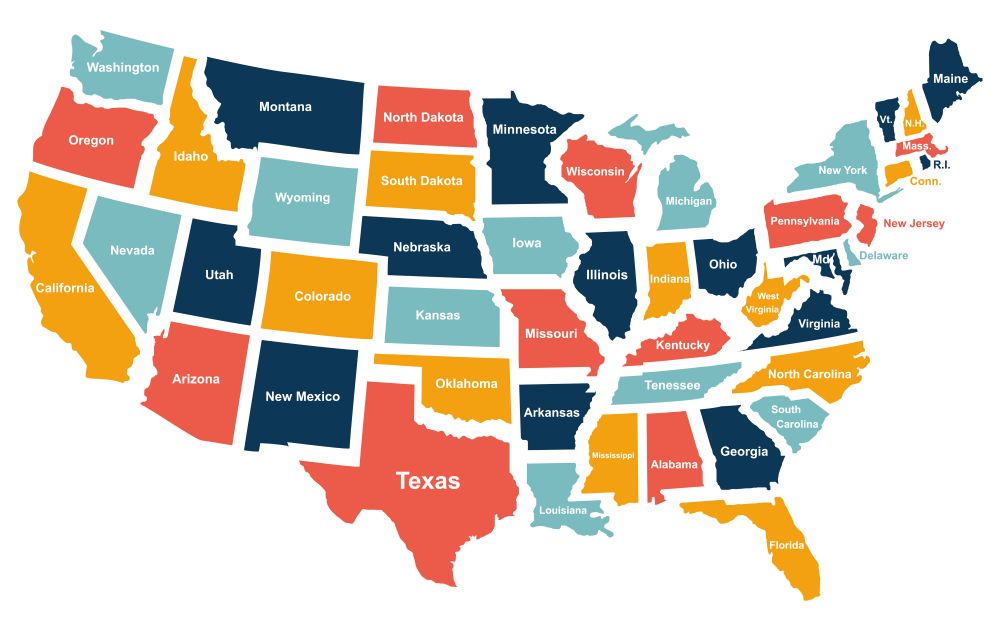

Most students build their college lists around rankings, acceptance rates, and program statistics. Those things matter. But there’s a variable that families often overlook until students are already enrolled and are living with the consequences: the state.
A university’s location has far more nuanced factors to consider than just the weather. It determines your cost of living, the industries you can intern in, the professional networks you can build, and the kind of community you’ll call home for the next four years.
This guide breaks down the U.S. by region, highlighting the five states that consistently offer the strongest overall environments for college students based on academic resources, career opportunities, and quality of life.
How the U.S. Divides into College Regions
The United States divides into four broad regions: Northeast, Midwest, South, and West. Each has a distinct academic culture, cost profile, and industry ecosystem that are important considerations before you commit to a school.
Northeast
States include: Massachusetts, New York, Connecticut, Pennsylvania, New Jersey, Rhode Island, and more.
The Northeast is the most academically dense region in the country. It’s home to the highest concentration of elite research universities in the world, and the cities surrounding them. For example, Boston, New York, and Philadelphia are heavily involved with finance, biotech, healthcare, consulting, and media. The academic culture is known for being rigorous and research-oriented, and the professional networks students can build during four years in this region are among the strongest anywhere.
The trade-off, however, is the cost. The Northeast consistently ranks among the most expensive regions in the country for housing and everyday living. Winters are long and cold, particularly in Massachusetts and upstate New York. Students who thrive here are those who are academically driven, adapt to any environment, and are intentional about building professional connections during their time in school.
Notable schools:
| State | School |
Massachusetts | Harvard University |
| Massachusetts Institute of Technology | |
| Tufts University | |
| Boston University | |
New York | Columbia University |
| New York University | |
| Cornell University | |
| Connecticut | Yale University |
Pennsylvania | University of Pennsylvania |
| Carnegie Mellon University | |
| University of Pittsburgh | |
| Pennsylvania State University | |
| Rhode Island | Brown University |
New Jersey | Princeton University |
| Rutgers University |
Midwest
States include: Illinois, Michigan, Wisconsin, Ohio, Minnesota, Missouri, and more.
The Midwest offers some of the strongest research universities in the country at a significantly lower cost of living than either coast. The academic quality at flagship public universities such as Michigan, Wisconsin, and Illinois is top-tier, particularly in engineering, business, and the sciences. For the region, Chicago serves as the major financial and commercial hub, adding real career infrastructure to what might otherwise be a purely academic environment.
The Midwest tends to attract students who are equally academically driven without the constraints of living expenses in New York or San Francisco. Campus culture here tends to be more community-oriented, with strong athletic traditions and a slower overall pace. Unfortunately, the winters in much of the Midwest are genuinely harsh, which is worth accounting for if you’re coming from a warmer climate.
Notable schools:
| State | School |
| Michigan | University of Michigan–Ann Arbor |
Illinois | University of Chicago |
| Northwestern University | |
| University of Illinois Urbana-Champaign | |
| Wisconsin | University of Wisconsin–Madison |
Ohio | Case Western Reserve University |
| Ohio State University | |
| Minnesota | University of Minnesota–Twin Cities |
| Missouri | Washington University in St. Louis |
South
States include: Texas, Florida, Georgia, North Carolina, Tennessee, Virginia, and more.
The South has become one of the fastest-growing regions for both population and economic opportunity over the past decade. Cities like Austin, Atlanta, Nashville, and Charlotte have ventured into tech, healthcare, and finance, creating meaningful internship and career infrastructure for students in the region. The cost of living remains lower than the coasts, the climate is warmer, and the region is also home to some of the country’s premier universities.
For students who are career-focused and want access to a growing job market without the cost burden of coastal cities, the South is worth considering.
Notable schools:
| State | School |
Texas | Rice University |
| University of Texas at Austin | |
| Florida | University of Florida |
Georgia | Emory University |
| Georgia Institute of Technology | |
| Tennessee | Vanderbilt University |
North Carolina | Duke University |
| University of North Carolina at Chapel Hill | |
| South Carolina | Clemson University |
West
States include: California, Washington, Oregon, Arizona, Colorado, and more.
The West is the most geographically and culturally diverse region, anchored by California’s massive tech and entertainment ecosystem and the Pacific Northwest’s growing presence in cloud computing and biotech. For students interested in technology, engineering, entrepreneurship, or any field in the STEM industry, the West offers career access that no other region can fully replicate.
The UC system, Stanford, Caltech, and the University of Washington collectively represent some of the strongest STEM programs anywhere in the world. The climate is generally mild, the campuses are visually striking, and the surrounding culture tends toward innovation and openness. The cost of living in California in particular is among the highest in the country, and housing affordability is a genuine challenge for students in the Bay Area and Los Angeles.
Notable schools:
| State | School |
California | Stanford University |
| California Institute of Technology | |
| University of California, Berkeley | |
| University of California, Los Angeles | |
| University of Southern California | |
| University of California, San Diego | |
Washington | University of Washington |
| Seattle University | |
| Oregon | University of Oregon |
| Arizona | University of Arizona |
The Top 5 States for College Students
With that regional context in mind, here’s a closer look at the five states that consistently offer the strongest overall experience for college students across academics, career outcomes, and quality of life.
1. Massachusetts
Massachusetts is the academic capital of the United States. No other state concentrates this much research-university firepower in a select geographic area. Harvard, MIT, Tufts, Boston College, and Boston University all sit within a short distance of each other, and the connections between those institutions, through shared research, cross-registration programs, and a common alumni ecosystem, create a unique academic environment.
Beyond academics, Massachusetts has developed into one of the world’s leading biotech and life sciences hubs. The area around Kendall Square in Cambridge has more concentrated pharmaceutical and biotech companies per square mile than almost anywhere else on earth. For students in biology, chemistry, pre-med, neuroscience, or any related field, the research and internship access this creates is extraordinary.
Boston is also one of the most student-friendly cities in the country. It’s safe, walkable, culturally rich, and built around a community that values academic rigor and education. The winter climate is cold and long, and the cost of living is high. However, most students who spend four years in Boston notice how the environment actively accelerates their development.
Best fit for: Students targeting top academic programs, STEM research, biotech and life sciences careers, or graduate school preparation.
Representative schools: MIT, Harvard, Tufts, Boston College, Boston University
2. New York
No state offers what New York does in terms of raw professional opportunity. New York City is simultaneously the global capital of finance, media, fashion, advertising, publishing, and the arts. For students who want to build careers in any of those industries, there is simply no better place to spend four years.
New York City is expensive, but it is also highly competitive and relentlessly stimulating. Students who thrive here tend to be ambitious, adaptable, and genuinely energized by urban environments. Students who need space, quiet, or a slower pace to do their best work may find it overwhelming.
Best fit for: Students targeting finance, consulting, media, the arts, or any career where New York City networks and internships provide a direct advantage.
Representative schools: Columbia, Cornell, NYU, University of Rochester
3. California
California’s scale is a bit more complex. It has the largest public university system in the country, several of the world’s top private research universities, a tech industry that generates more economic output than most countries, and a climate that makes year-round outdoor activity a part of daily life.
For students interested in computer science, engineering, data science, entrepreneurship, film and entertainment, or any technology-adjacent field, California’s advantages are structural. Stanford’s proximity to Sand Hill Road and the venture capital community means students there interact with startup culture as a matter of course. UC Berkeley and UCLA funnel graduates into the major tech companies at an unmatched rate. UC San Diego has built a research profile in biotech and marine science that rivals programs at much more famous institutions.
Still, the cost of living is a major issue, particularly in the Bay Area and Los Angeles. Housing is the primary issue, and students should research and budget for it specifically rather than treating it as an afterthought.
Best fit for: Students targeting technology, engineering, data science, entrepreneurship, entertainment, or careers tied to the West Coast tech companies.
Representative schools: Stanford, Caltech, UC Berkeley, UCLA, USC, UC San Diego
4. Illinois
Illinois occupies a unique position in American higher education: it has two renowned elite private universities and one of the most respected engineering and CS programs at a public institution, all within a state whose cost of living is significantly lower than either coast.
The University of Chicago is one of the most intellectually demanding undergraduate environments in the country, with a Core Curriculum that requires every student to engage with a rigorous set of foundational courses across the humanities, social sciences, and natural sciences. Northwestern, in Evanston, just north of Chicago, combines strong research programs with deep connections to journalism, theater, law, and business.
Chicago itself has grown significantly as a professional destination for graduates, particularly in finance, consulting, healthcare, and increasingly technology. It’s a real city with real career infrastructure, without the cost or intensity of New York or San Francisco.
Best fit for: Students who want elite academic credentials with a lower cost of living and strong career access to finance, consulting, and technology.
Representative schools: University of Chicago, Northwestern, UIUC
5. Pennsylvania
Pennsylvania is often underrated in college conversations, but it punches well above its geographic size in terms of academic quality and career opportunities. UPenn and Carnegie Mellon represent two of the strongest programs in the country in business and technology.
Penn’s Wharton School carries arguably the strongest undergraduate business brand in the country. Carnegie Mellon’s School of Computer Science is consistently ranked among the very best in the world, with alumni networks that extend deep into Silicon Valley, Wall Street, and virtually every major tech company.
Compared to New York and California, Pennsylvania’s cost of living is more manageable, allowing students to maintain a higher quality of life without worrying about financial stress. The state sits between the Northeast and Mid-Atlantic in terms of climate, with four distinct seasons, the winters being particularly cold but not extreme.
Best fit for: Students targeting business, finance, computer science, robotics, or AI, who want elite program quality with a lower cost burden than coastal alternatives.
Representative schools: University of Pennsylvania, Carnegie Mellon, University of Pittsburgh, Penn State
Thinking About State as Part of Your College Decision
The right state for you depends on what you want your four years to produce. If research and academic depth are the priority, Massachusetts or New York’s academic ecosystems are hard to match. If you want to be inside the tech industry from day one, California is your best path. If elite credentials with lower financial pressure are your priorities, Illinois and Pennsylvania consistently deliver.
A few questions worth working through as you build your college list:
1. What industry do you want to work in after graduation?
Some industries are geographically concentrated. If you want to work in tech, being in California or Washington during your undergraduate years creates advantages that are hard to replicate from the Midwest or South. If you want finance, New York is your best option.
2. What’s your realistic housing and living budget?
The cost difference between studying in California and studying in Illinois can be substantial over four years. That difference can translate into reduced loan burden, which affects your flexibility after graduation.
3. What kind of campus and city environment do you want to live in?
Some students do their best work in a dense urban environment. Others need more space and a slower pace. Neither is wrong, but knowing which describes you is useful information before committing to four years somewhere.
Since the school matters, so does the state. Building a college list that accounts for both produces better decisions than focusing on one and ignoring the other.
If you’d like help thinking through how location factors into your college list alongside academics, financial aid, and program fit, our team at Ivy Talent Education is here to help. Reach out to schedule a consultation and get guidance tailored to your goals and priorities.