
 中文
中文 Tiếng Việt

In the status quo, legacy preferences are prevalent, especially at highly selective institutions such as Harvard and Stanford. Recently, there have been several efforts to end this practice.
This article discusses the nature of legacy admissions, its pros and cons, its impact on Asian Americans, and the consequences of ending the practice. Read along to understand why some institutions continue this and why some ended theirs, especially as Asian American students navigate its effects on their college plans.
What are Legacy Admissions?
Legacy admissions, otherwise known as legacy preferences, are advancing prospects for applicants with relatives of the institution’s alumni. This legacy status often benefits the children or grandchildren of the alumni. It is a long-standing tradition among prestigious and selective schools, such as Harvard and Stanford University.
However, legacy preferences also manifest in different ways. While some schools prioritize legacies for admission, others have “slight advantages” in admission, such as Columbia University and the University of Virginia.
Why Do Colleges Have Legacy Admissions?
Historically, the practice began in the 1920s when Jewish immigrants started contesting for spaces at Ivy League Colleges, which were predominantly Protestant in nature. However, for the American elites to keep the Jewish immigrants from accessing these facilities, they shifted admissions from meritocracy to elitism and nepotism. They granted entry to elite Jewish applicants who had assimilated into the “mainstream American culture.”
Alumni Engagement and Donations
Universities rely heavily on private donations to fund scholarships, research initiatives, campus developments, and endowments. Administrators often argue that maintaining strong intergenerational ties encourages alumni to remain emotionally and financially invested in the institution. When alumni believe their children may receive some consideration in admissions, they may feel a deeper connection to the school and a greater incentive to donate.
Institutional Continuity and Community Familiarity
Some universities suggest that legacy students arrive with a deeper understanding of campus traditions, academic expectations, and institutional identity. A notable example of this claim is Texas A&M’s board of regents’ claim that “they already have to me kind of an ingrained a little bit about what they’re getting into.”
Criticisms and Ethical Concerns
While institutions that follow legacy preferences in their admissions have cited reasons why the practice is justifiable, it has also attracted criticism and ethical concerns regarding how these institutions are managed.
Socioeconomic and Racial Disparities
Dissidents of the practice have called it the “affirmative action” for white people, following a study conducted by Opportunity Insights, where they quantified the admissions statistics rate of legacies in schools that practice it, vis-à-vis the schools that do not.
Some notable results of their study also found that legacy students are more likely to be white and rich. Researchers have found that, regardless of their legacy status, applicants whose parents’ income and education are considered are still “33% more likely to be admitted than applicants with the same test scores.” This means that even if you were more qualified based on merits alone, more financially capable students have a generally higher statistical advantage at getting in, just based on their parents’ income tax records alone.
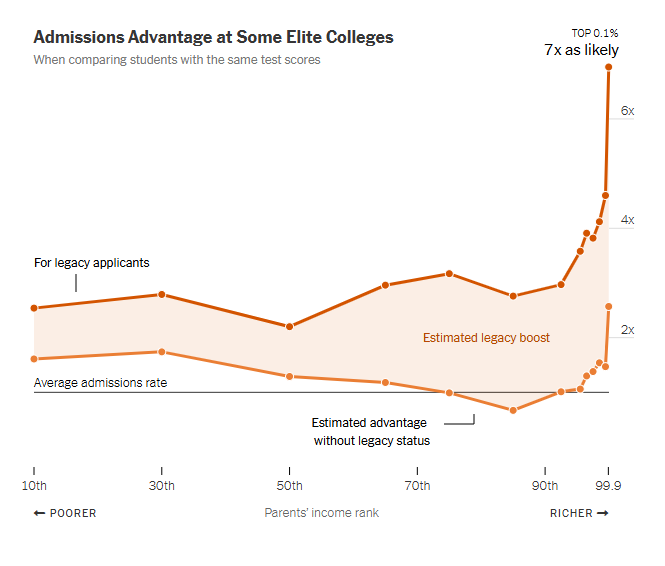
Source: The New York Times
Legal Involvement and Policy Changes
Unlike the legal challenges brought by Students for Fair Admissions (SFFA) against affirmative action, there has been little to no legal involvement in legacy admissions. The issue intensified following the 2023 Supreme Court ruling against affirmative action, resulting in a total ban on racial preferences in admissions across the states. Some institutions, such as Wesleyan University and the American Enterprise Institute, found it unjustified to ban the practice while allowing legacy admissions to continue, inevitably widening the inequality gap.
Selected Universities Banned the Practice
In recent years, some universities and even some states have terminated their legacy programs or banned the practice. Some institutions have never considered or practiced legacy preferences, while some ended theirs before the end of affirmative action, and now, there have been more recent additions to the list.
Institutions that Never Practiced Legacy Admissions:
- California Institute of Technology
- The Cooper Union for the Advancement of Science and Art
- Massachusetts Institute of Technology (MIT)
- University of Washington
Institutions that Ended the Practice Before 2023
Here is a list of colleges/universities per state that ended the practice from prior decades to recent decades. These institutions submit their data on a Common Data Set, which updates their information on admissions.
- Amherst College
- Auburn University
- Bryn Mawr College
- California State University, Long Beach
- Carnegie Mellon University
- Chapman University
- Clark University
- Emerson College
- George Mason University
- Georgia Institute of Technology
- Hampton University
- Johns Hopkins University
- Mercer University
- Northeastern University
- Pomona College
- Purdue University, Main Campus
- Saint Louis University
- Texas A&M University
- University of California, Berkeley
- University of California, Davis
- University of California, Irvine
- University of California, Los Angeles
- University of California, Merced
- University of California, Riverside
- University of California, San Diego
- University of California, San Francisco
- University of California, Santa Barbara
- University of California, Santa Cruz
- University of Colorado, Boulder
- University of Connecticut
- University of Florida
- University of Illinois, Urbana-Champaign
- University of Maryland
- University of San Francisco
- University of Texas, Arlington
- University of Texas, Austin
- University of Texas, Dallas
- University of Texas, El Paso
- University of Texas, Permian Basin
- University of Texas, Rio Grande Valley
- University of Texas, San Antonio
- University of Texas, Tyler
Institutions that Ended the Practice Recently
Following the end of affirmative action, institutions no longer entertained legacy admissions in their process. The following are some colleges and universities that ended their legacy admissions:
- Carleton College
- Loyola Marymount University
- Occidental College
- University of Minnesota-Twin Cities
- University of Pittsburgh
- Virginia Tech
- Wesleyan University
Legacy Preferences and Asian-American High-Performing Students
SFFA expert witness, Duke professor Peter S. Arcidiacono, in his filings, extracted statistics for admission of legacies. His study concluded that white people are disproportionately favored, with 21.5%, while Asian-American students are only 6.63%. Ironically, in a separate study by Professor Sharad Goel and Josh Grossman, Asian American students are also 28% less likely to be admitted to highly selective institutions despite being top scorers during admission.
Moreover, geographic preferences also play a role in admissions for legacies. A general practice among U.S. universities and colleges is to maintain a diverse geographic background among their student bodies. However, Grossman also explains that selective institutions are less likely to admit students from areas with higher concentrations of Asian Americans, such as California and Washington. In 2022, Ivy League schools increased admissions from rural America. Statistics show that only 1% Asian American students graduated from rural America, while 5% were white Americans.
Removing Legacy Admissions - Results
Harvard admissions noted that a high-performing student from a low-income background can increase their chances from 15% to 24%. However, legacy students with the same rating can see their odds bumping from 15% to 55% compared to others.
There are many questions about the effects of banning legacy admissions, such as the decrease in financial support from alumni donors or the impact on student body diversity. For the institutions, ending legacy admissions has different financial effects, depending on the institution. The parental income distribution of legacies will decrease from 15.8% to 13.7%, increasing the share from the bottom 60% from 15.7% to 16.6%. However, given the financial policies of such institutions, the shift would hardly change the composition of admissions since lower-income students are less likely to continue their education from highly selective and expensive institutions. What is most likely to happen is that they might only replace legacies from privileged backgrounds with non-legacies from privileged backgrounds to support the institution’s financial burden.
Alternatively, some believe that the end of this practice acts as an equalizing force for the harms done to diversity by ending affirmative action, as it unfairly holds spots for their beneficiaries, who are more often than not, white and rich. Johns Hopkins University ended the practice a decade ago, and the results show that, while the school did indeed need to find new endeavors for generous financial aid, it showed a significant increase in not just non-white students, such as Asians, Blacks, Latinos, or Hispanics, but also from low-income students, increasing their demographic diversity.
Need Help? Ivy Talent Education can Guide You!
Shifting policies and mechanisms in college admissions are prevalent. The end of affirmative action has indirectly jolted reviews on legacy preferences and how it continues to affect applicants from different backgrounds.
Here at Ivy Talent Education, we provide ample information and the key interpretations for these events that help you and your family navigate your future college plans. We are always ready to provide you with the best solutions and guidance for your goals. Contact us for a consultation to know the best strategy for navigating your future.