
 中文
中文 Tiếng Việt

The Supreme Court’s ruling on the unconstitutionality of Affirmative Action has triggered a cascade of effects in the academe. College admission policies have started to shift, questions on campus diversity, and students’ college and university selections push students to once again be busy. With the sudden end of affirmative action in the US is the onset of a rapid change in educational policies and opportunities.
This article explores and interprets this shift in higher education institutions, the advantages and disadvantages it brings, and practical ways to navigate this change.
Here is a comprehensive guide for Asian American students in navigating the end of Affirmative Action, complete with options and other opportunities you and your family can consider.
What is Affirmative Action?
Affirmative action refers to the policy aimed at promoting better opportunities for underrepresented groups in the workplace and higher education institutions. As a movement that has its beginnings that can be traced to as early as the 1960s Civil Rights Movement in the US, it’s a policy with a primary focus on fighting discrimination based on racial and ethnic groups.
In 1978, however, affirmative action was challenged in court in Regents of the University of California v. Bakke.
Allan Bakke, an applicant to the University of California, Davis medical school, was rejected twice and later sued the university for using race-based admission, claiming that it admitted minority students with lower grades and scores.
The Supreme Court decided that it was unconstitutional for UC Davis to reserve 16 out of 100 slots exclusively for minorities; however, Affirmative Action, which considered race in admissions to a diverse student body, was acceptable.
What are the Pros and Cons of this Policy?
While the policy is a step towards an intentional push against oppressive barriers, the ongoing debate on whether or not affirmative action effectively promotes diversity remains contentious.
The benefits of the policy are that it not only promotes a diverse culture in work and educational spaces but also gives underrepresented groups access to equal opportunities. However, some argue against this, claiming that the policy alienates other races into “special categories”, promotes reverse racism, and allows race and ethnic origins to outweigh the merits of students during admissions.
The above concerns then raise the question: Is it still a recognition of student diversity when socioeconomic factors are beyond the factors weighed for consideration?
What Changed in 2023?
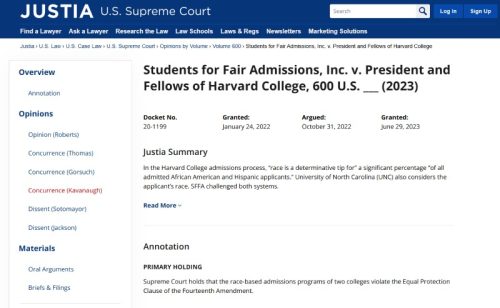
In 2022, the US Supreme Court received two cases from Students for Fair Admissions (SFFA) accusing Harvard and UNC-Chapel Hill of race-based admissions. SFFA and Edward Blum, a conservative legal strategist representing a group of Asian Americans, claimed that they were discriminated against during admissions.
Ultimately, the case reached its conclusion in 2023 when the Supreme Court rendered the decision that affirmative action in admissions is considered to be unconstitutional. Chief Justice John Roberts of the Supreme Court opined that a student must be treated based on his or her experiences as an individual rather than not on the basis of race.
As a result of the Supreme Court decision, the immediate end of affirmative action in colleges and universities followed closely after.
Source: Justia U.S. Supreme Court Center
What Higher Institutions Can Do Now
With this change, there are expectedly several changes that students, especially people of color (POC), will experience. Nevertheless, universities and colleges have remained committed to continue fostering diversity among their populations. Here are a few steps they have taken:
- Increase financial aid covering a range of costs from tuition, resources, and housing.
- Some colleges partner with high schools and non-profit organizations to support low-income students on their path to higher education.
- Private colleges, particularly in California, have strengthened ties with high schools and their counselors.
Long-standing Debate Around this Topic
Affirmative Action intends to benefit people who lack access to privilege such as better education or opportunities to advance in the career ladder. It also promotes diversity in educational and professional environments, enhancing performance and productivity due to unique backgrounds and experiences.
Oppositions to the policy have cited concerns about biased accommodations, which have led to qualified people, on merits alone, being overlooked due to racial quotas. Other oppositions have also cited that it treats minorities are still differently, defeating the purpose of equality. Furthermore, some students have concerns about “reverse racism”, favoring racial minorities over white people.

What the End of Affirmative Action May Mean for Asian American Applicants
Asian American applicants have been placed in a position of impasse since the declaration of the Affirmative Action policy has been declared to be unconstitutional. During the SFFA court trial, Asian Americans hoped that the ruling of the court would be in their favor and as a result increase efforts to eradicate barriers for the rest of the group. Admittedly, there are also differing opinions among these groups.
While some claim to be discriminated against, some claim that the racial considerations should have no bearing on admission. There were also concerns raised about undermatching due to the financial constraints of low to medium-income families. A consequence of this can prevent well-qualified students from entering highly selective schools.
Following the year 2023, a noticeable decline in POC admissions has been recorded from highly selective schools such as Yale, Dartmouth, and Princeton. However, there was also an increase in Asian American students at Harvard, from 37% in 2024 to 41% in 2025.
Broader System Effects
Reverting to the Privileged Status Quo
Since the policy was aimed not only at supporting families from less privileged backgrounds, but also especially from racial barriers, institutions will see an influx of students coming from more economically stable backgrounds and more resource-abundant schools, most of whom are on non-POC descent. This reverts the system to the status quo, where disparities become more evident for the POC students.
University Policies Shifting
With the promise of diversity, universities have adapted efforts to sustain welcoming facilities for every student. Some have shifted to a holistic review of the admission process, omitting race as a factor and focusing more on merits.
Employment Opportunities and Disparities
Unfortunately, non-white students will see a decrease in workplace opportunities following the policy’s end. With the decline in admission to highly selective universities, future employers may have a bias against an applicant’s educational background.
5 Ways Students Can Navigate This New Landscape as an Asian American Student
Nevertheless, there are several ways an Asian American student like you can navigate this new terrain. Here are some:
1. Start the discussion on realistic schools and universities you can enter with your family
As an Asian American, it is important to talk to your family about factors such as location, socioeconomic status, and current academic standing that may affect your college applications.
2. Consider applying to institutions with test-dependent applications
Following the narrowing options for costly institutions, consider applying to institutions with test-dependent admissions for better chances at acceptance and opportunities.
3. Seek assistance and guidance from your counselor and mentors
Your counselor and mentors can help you plan your career path clearly and objectively. Consult with them about your situation and preferences for better planning.
4. Seek scholarship opportunities
If a primary problem that concerns you is financial constraints, there are several ways to get a scholarship even outside your institution. Even Ivy League Yale has expanded their scholarship opportunities.
5. Contact Ivy Talent Education for the ultimate guide
The importance of strategic planning for college admissions is widely felt among students and families alike. Big policy changes can cause anxiety; however, with proper and professional guidance and planning, your application to your preferred institutions will become manageable.
At Ivy Talent Education, we ensure that you are presented with options, solutions, and optimal results for your college plans. Whether you’re aiming for Harvard or any other top U.S. universities, feel free to share your insights and contact us; our top-notch professional team can help you get started.