
 中文
中文 Tiếng Việt

It’s that time of the year again! College admission decisions are now approaching their release this spring. This means receiving one of three outcomes that will shape your life for the next four years: admitted, denied, or waitlisted. For many families, being waitlisted can feel confusing. What does that decision really mean? Is it good news, or a soft rejection? What should you do next?
At Ivy Talent Education, we work with students through this exact situation every year. We understand the confusion, and we tell families one thing: a waitlist is not a rejection. If anything, it offers a hopeful possibility of getting in through a second review pool.
What many do not know is that students can lose their waitlist opportunity within the first week without even realizing it. They respond late, send the wrong updates, or worse, they do not reply at all. By the time they decide to act, admissions offices have already moved to the next stage.
Waitlist decisions are strategic, and so should be your response. In this article, we explain how colleges manage waitlists and what recent data reveal about real admission statistics for waitlisted students. We also share five proven steps that can strengthen a student’s chance of getting selected. Let’s break down what actually works.
Why Colleges Use Waitlists
Before anything, it is important that we give this assurance: If you are waitlisted, you are neither admitted nor rejected. The good news is your application met the school’s standards. However, the college can only offer you a spot after the initially accepted students make their decisions. That is, if someone declines or decides not to enroll, your spot may become available.
Universities build their student population using a process called yield management. Yield refers to the percentage of accepted students who actually enroll in an institution.
Because no school knows exactly how many admitted students will say yes, admissions offices use waitlists to:
- Adjust class size if enrollment falls short
- Maintain academic and demographic balance
- Avoid exceeding available dorms, faculty, and classroom space
Is the Waitlist Ranked?
Most U.S. colleges do not rank their waitlists.
Instead, when a slot becomes available, admissions officers review the waitlist pool holistically. They look for students that could perfectly complete the class profile.
Some factors they consider are the following:
- Intended major needs
- Gender balance
- Geographic diversity
- International representation
- Institutional priorities
- Special talents in athletics, arts, or research
We can’t know the exact details since these decisions are internal, but one thing is certain: as long as you’re on the waitlist, you still stand a chance of getting accepted.
Yale University: What the Numbers Show
According to Yale University’s official announcement for the Class of 2029, the university offered admission to 2,308 students from a pool of 50,227 applicants, while placing 943 candidates on the waitlist.
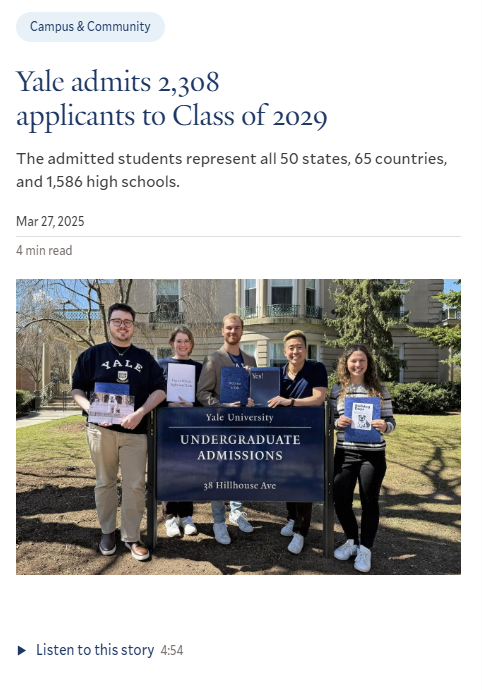
Source: Yale News
Historical data published in Yale’s Common Data Set (CDS) show that only a small percentage of waitlisted students are ultimately admitted. In typical cycles, the waitlist admission rate is usually in the low single digits, even though the waitlist itself can include several hundred students. During the COVID-19 pandemic, many highly selective institutions experienced temporary fluctuations in yield rates, leading to slightly higher waitlist activity.
While a quick look at the overall conversion rates may seem daunting, waitlist applicants who employ the right strategy can increase their individual success rate by 50% or more. The key lies in understanding exactly what admissions officers are looking for and taking targeted action.
Five Steps to Improve Your Chances
1. Confirm Your Interest Immediately
Accept your waitlist spot through the portal before the deadline, ideally within 72 hours (the earlier, the better!). If you wait too long, you might give the impression that you’re not interested in the spot, especially in schools that use the waitlist pool to quickly fill specific spots in the class
2. Submit Meaningful Updates
Stop passively waiting for a decision! You can stand out by sending an “update package.” The purpose of a waitlist update is to show your growth, not to repeat the material that the admissions office already read.
A strong “update package” can include:
- Academic updates: improved grades (for example, a stronger second semester), newly received honors, research progress, recent publications, and new advanced coursework
- Major-related progress: competitions, internships, portfolio work, projects with measurable impact
- Leadership and activities: a new leadership role, expanded responsibilities, sustained community work
- School fit: emphasize that you can contribute to campus initiatives, either through student organizations, research groups, courses, or community service
3. Letter of Continued Interest (LOCI)
Some people call it a “love letter,” but in formal admissions language, it is called a Letter of Continued Interest (LOCI).
A strong LOCI is typically one to two pages. It includes:
- Update on recent achievements: your most important accomplishments since applying (grades, awards, leadership, projects)
- Alignment with the school: detailed, school-specific reasons that show genuine fit (programs, faculty, labs, curriculum, campus communities)
- Expression of commitment: how strongly you would consider enrolling if offered admission
What to avoid: Simply repeating your original application or relying on generic templates.
4. Add New Recommendation letter
If the college accepts additional materials, an extra recommendation can be helpful when it adds a new perspective or strengthens a part of your application that wasn’t fully highlighted before.
Strong recommendations may come from:
- A current teacher in a rigorous course related to your intended major
- A research mentor
- An internship supervisor
- A community service leader
Make sure the recommender understands that you are waitlisted and writes with emphasis on your growth.
5. Demonstrate Interest in the Right Amount
From April through June, we recommend one to two meaningful touchpoints per month, as long as the school allows it.
Here are some examples of high-quality outreach:
- Attending an online initiative by the school and sending a thoughtful follow-up reflection
- Sharing takeaways from a conversation with a current student, faculty, or alumni
- Submitting a significant update (grades, award, competition result, published work)
Please avoid sending weekly emails. Overcommunication signals anxiety and may frustrate busy admissions staff. We do not want to come off as obnoxious, of course, as that would lower our chance of getting accepted!
The Emotional Reality of the Waitlist
The waitlist period can feel uncertain and frustrating as you may feel suspended between outcomes for a long time. We fully understand that struggle.
In most cases, colleges do not start moving students off the waitlist until after May 1. As a safety net, you should move forward with the other offers you currently have, submit your enrollment deposit, and formally confirm your attendance. If you later receive an offer from a waitlisted school between June and August, you should promptly notify the college where you submitted your deposit and respectfully inform them that you will no longer be enrolling.
Remember, the outcome of a waitlist decision is ultimately beyond your control, so this is not the time to dwell on uncertainty. Avoid applying to a single school so you can have back-ups! If you’re waitlisted at your top choice, focus on exploring the schools that have already accepted you. Revisit your options, evaluate which environment best fits your academic and personal goals, and move forward with confidence. Trust that the path ahead will unfold as it is always meant to.
If you are currently navigating the waitlist process and feeling unsure about how to strengthen your materials, communicate with admissions officers, or realistically assess your chances of being admitted, we’re here to help. Contact us to schedule a free consultation session. Our team can guide you through a strategic next step and help you make informed decisions during this critical period.