
 中文
中文 Tiếng Việt

Many families believe that attending a competitive high school automatically gives students an advantage in college admissions. Schools with strong academic reputations, rigorous coursework, and impressive college acceptance rates are often seen as the ideal launchpad for top universities.
However, the reality is more complicated.
At highly competitive schools, students are surrounded by equally motivated and high-achieving peers. Advanced classes are the norm, leadership roles are common, and many students pursue similar extracurricular opportunities. When dozens of applicants from the same high school apply to the same universities, admissions officers often evaluate them side by side. In these situations, strong grades and impressive activities alone may not be enough to stand out.
After more than 17 years of guiding students through the college admissions process, our consulting team has repeatedly observed this pattern: when applicants come from rigorous, high-performing schools, the differentiator is rarely effort alone, but clarity, positioning, and the ability to demonstrate meaningful impact. In this article, we share five strategies that help students distinguish themselves in competitive high school environments, approaches we have seen help applicants present stronger, more compelling profiles in the college admissions process.
The Reality Behind Top High Schools
In a regular high school, a student with a 3.8 GPA might place near the top of the class. But in schools that are more prestigious and competitive, those with similar GPAs could be around the middle percentile of students.
However, not placing in the top ranks of your school despite having a high GPA does not mean one cannot get into their dream college. Admissions officers often receive a detailed School Profile of the student’s current school, and it helps them assess the backgrounds of their students. According to the College Board, an effective school profile includes key elements such as contact information for relevant personnel, such as the counseling staff, descriptions of the community and student body, an overview of available curriculum, grading and ranking procedures, standardized test score distributions, and the school’s college acceptance history.
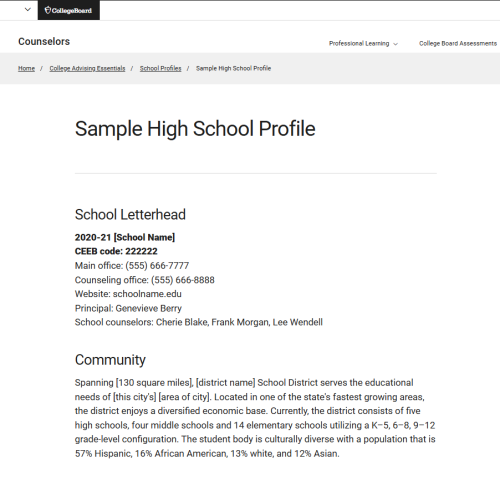
Source: College Board
How Do Colleges Evaluate Students from Competitive High Schools?
An admissions team often has a territory manager who manages and collects data from high schools located within a certain region. This information allows the team to understand the trends between local schools, such as analyzing the impact of academic culture on graduating students, the standards of grading, and even the college acceptance rate of students from those schools.
And when many students from one competitive high school apply to the same college, the admissions team often compares the applicants to one another. At times, several of these students may share similar profiles, like having the same AP classes, leadership positions, and even the same engagement experiences with local communities or initiatives. The team, therefore, searches for more unique qualities between the students when they examine their applications. They may look for aspects such as a strong admissions essay, a striking impression from a recommendation letter.

The Psychological Impact of Constant Comparison
Research suggests that well-performing schools often indicate a higher rate of students who compare their grades and experiences with one another and thus could foster an unhealthy level of competition. Some might feel like they aren’t doing enough and could even doubt their own strengths. And thus, some students’ self-esteem may be affected because of academic pressure.
Nonetheless, just because a student is surrounded by high-achieving peers doesn’t mean that they are falling behind. The academic environment is strong and competitive, and comparison could be a cause for demotivation. So, a way to shift one’s thinking from this could be done by reflecting on how a student may assert and effectively use their skills clearly and strategically despite being surrounded by competitive peers.
5 Tips to Stand Out in Competitive High Schools
1. Build a Strong Academic Reputation
Although grades make up a good part of a successful application, maintaining a healthy, professional relationship with teachers and counselors can also help support it.
A student who engages in class discussions, submits homework on time, and demonstrates genuine interest in the subject often earns stronger recommendation letters. In highly competitive schools where many students have strong grades, a compelling teacher recommendation can meaningfully distinguish one applicant from another.
2. Build a Clear Narrative
Selective colleges are looking for students who bring something different to the table. Rather than trying to be equally strong in every area, students benefit from identifying a focused direction, which means developing depth over time.
For example, a student interested in biomedical engineering might pursue advanced science coursework, research experience, and related competitions. Another student passionate about public policy might combine debate, economics research, and community advocacy. Admissions officers are looking for students who demonstrate sustained engagement and growth in areas that connect logically to their academic interests.
When multiple applicants from the same school apply with similar GPAs and test scores, the student with a clear narrative tends to stand out.
3. Focus on Impact, Not Titles
Leadership titles are common nowadays in competitive high schools. Instead of asking how many leadership positions they hold, students should consider what measurable change they created. Did they expand a club’s reach, launch a new initiative, conduct publishable research, or influence policy within their community? Harvard University’s Graduate School of Education encourages students to move away from accumulating titles and instead focus on authentic community impact. The differentiating factor becomes depth of contribution and tangible results. If you are unsure how to present your impact effectively, our guide on how to strategically position your Common App activities explains exactly how to do this.
4. Plan Your Course Loads Strategically
Colleges understand that course rigor depends on the school and the student. They are not counting AP classes by number; they are asking whether the student made thoughtful academic choices. We often see students overload their schedules just to match their peers, and the result is predictable: grades drop, stress rises, and everything starts to feel rushed. That rarely helps an application.
A well-planned schedule that reflects a student’s strengths and academic interests usually leads to better performance and a stronger overall story. Taking more than what is required is impressive, but your learnings from these classes matter more.
5. Help Build a Supportive Environment
In highly competitive schools, it can be tempting to constantly compare achievements with classmates or feel pressure to share every accomplishment. However, excessive comparison can unintentionally increase stress for both you and those around you. While it is perfectly appropriate to celebrate milestones, it is equally important to maintain perspective. Constant comparison can create unnecessary pressure and shift focus away from growth and learning.
At the same time, students should avoid the opposite extreme of isolating themselves. When many classmates are applying to similar universities, it can be easy to view everyone as direct competition. In reality, some of the most successful students in competitive schools build strong networks with peers who share similar interests and academic goals. Study groups, collaborative projects, and supportive friendships not only make the academic experience healthier but also foster the kind of intellectual curiosity and teamwork that colleges value. Your peers often understand the pressures of a rigorous school environment better than anyone else.
In the long run, college admissions represent just one stage of a much longer journey. The relationships, resilience, and collaborative habits developed during high school often prove just as valuable as any single achievement.
The Importance of Strategic Guidance
In competitive high schools, effort is rarely the differentiator. Most students are motivated and capable. What separates outcomes is clarity. When many applicants share similar grades, test scores, and activities, positioning becomes critical.
Here at Ivy Talent Education, we are happy to help students and families take a step back from academic pressure and, more so, to guide students in improving their college applications and essays. We aim to align your list of coursework, extracurriculars, internships, and more and to tailor them to your preferred and chosen field of study in college. Ultimately, we hope to create a clear sense of direction that will help you navigate your academic life moving forward.
Feel free to contact us to schedule a free consultation session. Our education consultants are more than happy to help you personalize and strengthen your applications today!