
 中文
中文 Tiếng Việt

Students from the US and Canada applying for college admission may need to consider these two factors: Early Action and Regular Decision. In this article, we will look into both kinds of applications, what stands out among them, their pros and cons, financial aid, and other factors to consider.
Early Action is a non-binding commitment that allows students to apply beforehand and submit their applications to different colleges. Regular Decision, on the other hand, allows a student to apply to their chosen college during the regular application period. Both applications have their own sets of pros and cons, so when you’re applying, you must take note of these factors: your schedule, your grades, your commitment, and more.

What is Early Action?
Early Action is a non-binding commitment in which students submit their applications to different schools in advance. They are not required to commit to a certain school or to accept an offer.
This application is for students who want to submit their applications earlier and have their recommendation letters and essays prepared beforehand. Most colleges give students until May 1 to confirm their applications.
Pros for Early Action Application
- Less worry. If you submit your application early, you do not need to worry about college applications during the regular decision time period. You can enjoy your senior year and focus on your other priorities.
- More options. If you ever get rejected from an early application, you still have ample time to look for backup schools and consider other options.
- More time to prepare for college. When you receive your college admissions results, you have sufficient time to research your chosen college and prepare to move to college.
- Willingness. Applying for college early also shows college admissions that you are interested in the school of your choice, which gives your application a head start.
Cons for Early Action Application
Less time to prepare your application. When you consider Early Action, you have less time to write and revise your college application essay, which might affect its quality.
Recommendation letters. You will need to gather recommendations from your teachers and mentors before the deadline, which may take them some time to respond to.
What is Regular Decision?
Regular Decision is similar to Early Action, as both have non-binding commitments, and students may submit applications to different colleges without being expected to attend a specific school. However, unlike Early Action applications, Regular Decision applications happen later, so applicants receive results later in the school year.
If you need more time to decide on which school you want to attend, Regular Decision may be your best option. You can also improve your grades so they stand out better to college admissions.
Pros for Regular Decision Application
More time. Applying to colleges later gives students more time to decide on which school and major they want to pursue, if still undecided. You can check this article to help decide on which college you want to attend.
Less stress for college applications. Unlike Early Admissions, where you, as applicants, need to rush to prepare your application essays and recommendation letters, Regular Decision will give you more time to prepare and revise. Don’t forget to thank your professors for their letters!
Grades. If you have been struggling academically and it reflects in your previous report card grades, Regular Decision also gives time to improve your grades for the current semester to boost your chances of getting accepted.
Cons for Regular Decision Application
More Pressure. Your performance in the latter part of the semester is crucial for your college application, as your grades for that semester will be submitted to college admissions.
Hectic schedule. Since your results are released later than Early Action, which usually happens at the end of the semester, you will have a limited time to prepare and pack for your move to college.
Rejection. In the case that you get rejected in Regular Decision, you might not have enough time to apply to new colleges and look for backup schools, as compared to Early Action.
Timeline of Events
Application: Early Action applications usually happen in November, while Regular Decision applications happen in December or January.
Receiving Results: For Early Action, students receive their results around December to January, while Regular Decision Applications may receive theirs around March to April, or at the end of the school year.
Acceptance Rates for Early Action and Regular Decision
According to Harvard Magazine, for the class of 2028, Harvard College had an 8.7% Early Action acceptance rate, with 692 out of 7,921 applicants being admitted. However, Harvard Admissions had an acceptance rate of approximately 4.18% during Regular Decision applications for the class of 2029.
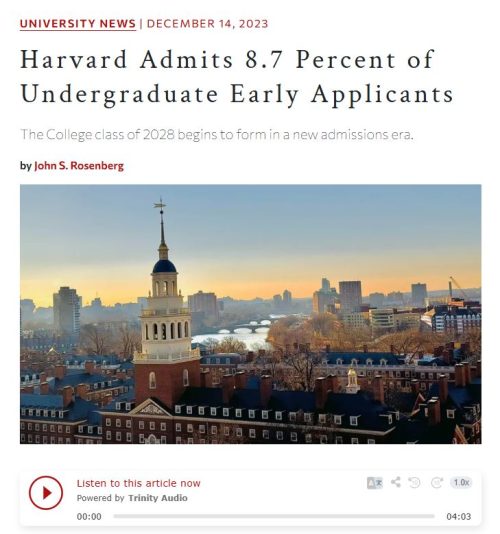
Source: Harvard Magazine
How Does Applying Early and Applying Late Affect College Admissions?
Applying Early
Caitlin Locke, director of undergraduate recruitment at the University of New Haven in Connecticut, stated that applying early for college shows college admissions that they are “super interested in attending that institution and that they would like to hear back quickly on their application.” It reflects the students’ willingness to devote their time and effort to submitting their essays early, making their college applications stand out.
Applying Late
Applying late, consequently, may not give students an early edge during college admissions. However, it also gives them more time to refine their applications, such as Highlighting Soft Skills for College Applications, Perfecting Your Common App Activity List, and How to Stand Out in College Admissions With Personal Branding. Here, students will have more time to write their essays, gather recommendation letters, and also improve their grades in the current semester. This can make their college applications stand out when college admissions examine carefully crafted resumes and essays.
Financial Aid
If you need to look into different financial aid options, it is important to consider the release of results for Early Action applications. You may need to confirm before you even receive your financial aid offer, which does not guarantee financial aid. However, Regular Decision applications receive their results around March or April, which is also the time financial aid results are released. Here, you will have more time to consider each financial aid package and are more guaranteed to receive it.
Here is an example of a financial aid package: Yale Financial Aid 2026: Full Tuition for Families Under $200K.
At Ivy Talent Education, we believe that your college admission journey is not just about getting into a college; it’s about finding the right path for long-term growth and success. In our College Admission Consulting Program, we value our students, inclusive support, personalized education, finding the right fit, and authentic expression. Ivy Talent’s students have been accepted to top universities, such as Cornell, Princeton, USC, and more. If you’re still deciding between an Early Action vs. a Regular Decision application, Ivy Talent is here to help you!