
 中文
中文 Tiếng Việt

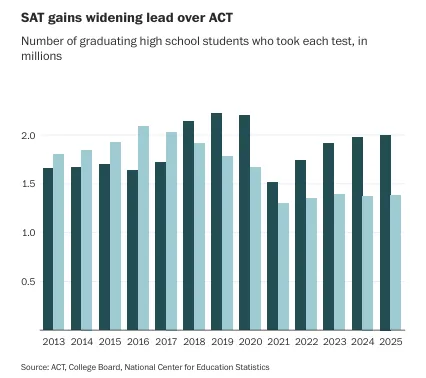
Nearly half of U.S. high school students in the Class of 2025 took the SAT, while only over a third took the ACT. The gap has been widening for years, and now the ACT itself has entered a new chapter after being acquired by a private equity firm. This development raises valid questions, one of which is whether or not taking the ACT is still a smart choice.
When so much is at stake to make the right testing decisions, uncertainty can quickly take over for parents and students already navigating the return of standardized testing at selective colleges.
In this article, the Ivy Talent Education consulting team breaks down what the ACT’s acquisition really means, why standardized testing continues to matter in college admissions, and how students can choose between the SAT and ACT with clarity and confidence, not guesswork.

SAT vs ACT: Key Differences Every Student Should Know
For families early in the admissions process, it is important to understand how the two exams compare.
SAT
The SAT is administered by the College Board and measures a student’s aptitude in reading, writing, and math. The exam is fully digital and adaptive (i.e., question difficulty adjusts based on student performance) with scores ranging from 400 to 1600.
ACT
Apart from the ACT’s assessment of a student’s English, math, reading, and science proficiency, it also includes an optional writing section. The scores of test takers can range between 1 to 36, and the students can take the exam online or through a test conducted onsite, depending on location. It follows a linear format and all students receive a similar sequence and difficulty of questions.
Nearly all U.S. colleges accept SAT and ACT scores equally. Admissions offices do not favor one test over the other. However, while both exams remain equally accepted by colleges, student behavior over the past several years tells a clear story: the SAT has become the more dominant testing option for U.S. high school students.
The comparison between the number of SAT and ACT test-takers between 2013 and 2025 demonstrates the widening gap between the two exams:
Source: Washington Post
In a rising trend, the SAT as represented by the dark-colored bars, is on a pattern of emerging as more favored by test takers than ACT for nearly a decade. This is a stark contrast to the public’s pulse ten years ago, when the ACT was the more popular choice among students and consistently outperformed the SAT in numbers. But fast forward to the U.S. graduating class of 2025: approximately 47% of students took the SAT, while 36% took the ACT.
The shift began in 2016 when the SAT underwent a major redesign, implementing measures such as scoring rule adjustments and question optimization. It triggered an opportunity for a pivot, and starting in 2018, it started losing its lead. Every year since, the SAT has increased its lead, steadily widening the gap.
Acquisition of ACT by Nexus Capital Management
In 2024, the nonprofit organization that had long overseen the ACT announced the sale of its testing operations to Nexus Capital Management, a private equity firm headquartered in Los Angeles. This announcement marked the first time one of the two major U.S. college entrance exams moved from nonprofit stewardship to being owned under private equity.
Following the acquisition, the ACT implemented several significant changes including the change in its leadership when a new chief executive officer took over and the redesign in terms of its test structure, wherein approximately 50 minutes were removed from the total testing time.
These updates were poised to directly address long-standing concerns that the ACT required excessive endurance compared with its main competitor. With the revised format now shorter than the SAT, ACT leadership has positioned the exam as a faster, more streamlined option for students.
Although these changes did not significantly alter how colleges view and accept ACT scores on equal footing with the SAT, the shift in public perception is apparent. While the full impact of the acquisition will unfold over time, the immediate takeaway is clear: the ACT, rather than remaining static in a changing admissions landscape, continues to wage an upstream swim against declining market share, actively adapting in response to increased competition from a fully digital SAT.
ACT Acquisition and Its Effect on College Admissions
Standardized tests continue to serve a specific role in college admissions. They offer admissions offices a reliable data point to contextualize grades, course rigor, and academic preparation of different applicants. As more selective colleges reinstate testing requirements, students have fewer opportunities to opt out of standardized exams entirely. This makes the structure, availability, and stability of testing options even more crucial.
The ACT’s shift to long-term equity ownership has prompted concerns from educators about long-term priorities. Private equity firms are accountable to investors, and financial performance plays a central role in decision-making. If the ACT struggles to remain profitable, potential risks go beyond financial. It includes narrower accessibility for students and reduced investment in test development and accessibility, not just higher registration fees.
Why Standardized Testing Still Matters
Despite years of test-optional policies, standardized exams remain a reliable tool that colleges can utilize to compare applicants across different academic environments.
Of course, grades alone do not fully capture the ability of a student. Course rigor varies widely, grading standards differ by school, and access to advanced coursework is uneven. Test scores help admissions teams evaluate academic readiness in a more standardized way that equalizes students from different educational curricula.
This is one reason why several highly selective institutions have reversed test-optional policies. For students, this means standardized testing is likely to remain a meaningful part of the admissions process, particularly for academically competitive colleges.
Now more than ever, choosing the right exam has become just as important as going in strategically and well-prepared for an examination.

SAT vs ACT: How Students Should Choose Strategically
The best test is not the most popular one. Rather, it is the test that allows a student to demonstrate their strengths most effectively.
Students often perform better on the SAT if they are:
- Comfortable with digital testing environments
- Excel at problem-solving and pattern recognition, and
- Prefer adaptive testing that rewards precision
On the other hand, students often perform better on the ACT if they:
- Work well under faster pacing
- Prefer predictable question difficulty, and
- Are strong in interpreting charts, graphs, and data
Each student brings a different strength in their application. The choice between the two tests is best decided by understanding one’s strengths, aligning one’s testing strategy on the basis of results and fit, not on headlines or market trends.
In practice, taking a diagnostic test for both exams early in high school can provide valuable clarity. For many students, adapting has become easier once they experience and get the opportunity to compare both formats.
Guidance from Ivy Talent Consultant
The ACT’s acquisition by Nexus Capital Management reflects a broader shift in how standardized testing is developing in the U.S. As the SAT continues to grow in popularity, the ACT remains a widely accepted and actively updated option.
For now, students still benefit from having two major exams recognized equally by colleges, and standardized testing continues to play a meaningful role in admissions decisions at selective schools.
Periods of change often create anxiety. The reality is that students do not need a prediction of testing trends to succeed. With the right planning, flexibility, and guidance, standardized exams can remain a manageable part of the application process rather than a cause for pressure.
If you are unsure whether the SAT or ACT makes more sense, or if you’re navigating your plans for testing around your college list, the Ivy Talent Education team is here to help with tailored solutions according to your targets, timeline, and priorities.
Contact us to schedule a free consultation, and our consultant will help you get started with a personalized planning approach.